Cas Dansa is my dance studio's performing group. Every Friday all the girls who perform with the studio practice for three hours.
We teach the younger girls dances that have been passed down for years. We also choreograph or make up new dances with all the girls.
We do a couple performances annually. Every year we perform at Milwaukee's Irish Fest, Chicago's Celtic Fest, The Burns Supper, and The Feast of the Haggis.
The Burns Supper and The Feast of the Haggis are both St. Andrew Society dinners. They are very formal and we always dress up after we perform and then eat dinner with anyone else.
Irish Fest and Celtic Fest are both performances outside at huge festivals where there are many different things to do such as watch the bag pipe bands or go to booths that sell Celtic jewelry or paintings.
Saturday, December 5, 2009

Tuesday, December 1, 2009
A Highland Dancer's Schedule
I am at the highest level of highland dance and currently preparing for Regionals. If i do well enough at Regionals this year, I'll make it to Nationals.
Every week I have Highland Dance class three nights a week. On Tuesdays and Thursdays I have a two hour dance class. On Fridays I have dance class for three hours.
On Wednesdays I have an hour and a half ballet class and a half hour pointe class. Ballet helps me to learn to be graceful in Highland dance. Highland dance originated from ballet therefore it helps me to be a better highland dancer.
On days like Mondays, Wednesdays, Saturdays, and Sundays when I don't have dance class I practice at home for at least an hour.
Some Saturdays however, I have a competition or a performance.
Every week I have Highland Dance class three nights a week. On Tuesdays and Thursdays I have a two hour dance class. On Fridays I have dance class for three hours.
On Wednesdays I have an hour and a half ballet class and a half hour pointe class. Ballet helps me to learn to be graceful in Highland dance. Highland dance originated from ballet therefore it helps me to be a better highland dancer.
On days like Mondays, Wednesdays, Saturdays, and Sundays when I don't have dance class I practice at home for at least an hour.
Some Saturdays however, I have a competition or a performance.
Sunday, November 29, 2009
History of Dances
The Sword Dance is done over swords placed on the ground in a cross. While doing this dance you move in and out of the swords placed on the ground.
This dance was symbolically done by soldiers before they went off to war. As a soldier if you touched the sword with your feet at some point in the dance, it was said that you would die at war.
Another dance that has a story background is the sailors hornpipe. In this dance the dancer dresses up as a sailor. Many of the different steps of the dance imitate actions of sailors such as pulling ropes, looking out for enemy boats, or saying good bye as the ship leave dock.
One last dance that has rich history is the Irish Jig. In this dance the dancers dress up in a dress and apron. The story for this dance is that a house maid that hung up laundry to dry outside is very angry with the children in the town. The children let a muddy pig loose and the pig pulled down all of the laundry onto the ground.
The steps in the dance are all very angry. The dancer has her hands in fists and she is stomping throughout the whole dance.


This dance was symbolically done by soldiers before they went off to war. As a soldier if you touched the sword with your feet at some point in the dance, it was said that you would die at war.
Another dance that has a story background is the sailors hornpipe. In this dance the dancer dresses up as a sailor. Many of the different steps of the dance imitate actions of sailors such as pulling ropes, looking out for enemy boats, or saying good bye as the ship leave dock.
One last dance that has rich history is the Irish Jig. In this dance the dancers dress up in a dress and apron. The story for this dance is that a house maid that hung up laundry to dry outside is very angry with the children in the town. The children let a muddy pig loose and the pig pulled down all of the laundry onto the ground.
The steps in the dance are all very angry. The dancer has her hands in fists and she is stomping throughout the whole dance.
Wednesday, November 25, 2009
Competions
For most highland dancers competing is a dancers favorite part. We get the privilege of traveling all around America. We make new friends from all over the country.
At most competitions there are four dances done. The dances and the length of the dances vary with the level that you are in.
Some competitions are called Championships. Championship competitions have required things each dancer must do. In each dance there are sections of the dance called steps. Each dancer in a Championship competition is required to do the same steps.
Another competition is Regional. Regionals is a competition that is for your region. (example: Midwest)The only thing you need to do to compete in regionals is live in that region and be at the highest level of highland dancing.
At regionals if you are awarded Champion, 1st runner up, or 2nd runner in your age group, you qualify to go to Nationals or USIRs(United States Inter-Regional Championships). USIRs is all the best dancers throughout the United States coming to one competition and competing against each other.
Becoming a USIR Champion means that you are the best highland dancer throughout the whole U.S. in that age group.
This link gives more informtaion about the history of USIR and where it is being held in 2010.
At most competitions there are four dances done. The dances and the length of the dances vary with the level that you are in.
Some competitions are called Championships. Championship competitions have required things each dancer must do. In each dance there are sections of the dance called steps. Each dancer in a Championship competition is required to do the same steps.
Another competition is Regional. Regionals is a competition that is for your region. (example: Midwest)The only thing you need to do to compete in regionals is live in that region and be at the highest level of highland dancing.
At regionals if you are awarded Champion, 1st runner up, or 2nd runner in your age group, you qualify to go to Nationals or USIRs(United States Inter-Regional Championships). USIRs is all the best dancers throughout the United States coming to one competition and competing against each other.
Becoming a USIR Champion means that you are the best highland dancer throughout the whole U.S. in that age group.
This link gives more informtaion about the history of USIR and where it is being held in 2010.
Sunday, November 22, 2009
What Music Do Highland Dancers Dance To?
At competitions highland dancers dance to bagpipes. While practicing and getting ready for competitions most dancers use bagpipes on a CD. At competitions a live bagpiper plays the music for each dancer. Every song is played on bagpipe.
For the choreography, which is something that you are able to do at the premier level, you get to pick your own music. You make up your own dance to go with this music.
The music for competitions should have bagpipes in it. It can be fun though. It could be by a band with bagpipes in it. So it would also have drumming and maybe even guitar/bass in it.
This web page explains how a bagpipe works and makes sound. It includes links for what each of the specific parts of the bagpipe do.

For the choreography, which is something that you are able to do at the premier level, you get to pick your own music. You make up your own dance to go with this music.
The music for competitions should have bagpipes in it. It can be fun though. It could be by a band with bagpipes in it. So it would also have drumming and maybe even guitar/bass in it.
This web page explains how a bagpipe works and makes sound. It includes links for what each of the specific parts of the bagpipe do.
Saturday, November 21, 2009
Levels of Highalnd Dancing
The first level in Highland dancing is Primary. This is for children under seven. If you begin highland dance at an age younger than seven you would compete in this group. This is the only group that has an age requirement.
Once you are seven, you are automatically bumped up into the Beginner category. After beginner is Novice. Neither of these level have age requirements.
To move onto the next level you must meet a requirement. Every dancer gets something called a F.U.S.T.A.(Federation of United States Teachers and Adjudicators) card. This card is like your dancer I.D. It is how you register to compete in competitions.
At a competition if you receive a first, second, or third place, you get a stamp on the back of your. Once you receive six stamps you move onto the next level. This applies for the Beginner and Novice levels of highland dance.
After you get six stamps on your Novice card, you move into a level called Intermediate. This level is preparing you for Premier or the highest level of dance. Intermediate doesn't require anything to move on. You stay in Intermediate for a whole year and you are automatically moved into Premier.
Once you get to Premier, it is the highest level so you don't move up. You start to receive money at competitions instead of medals and trophies. You can qualify for Nationals once you are in Premier. It is also much more difficult to win. The groups get much bigger.
As an example of the groups, here are competition results. Scroll to the bottom of the page. It lists the dance, the dancers name, the place they received, the age group and of course the level they're in.
Once you are seven, you are automatically bumped up into the Beginner category. After beginner is Novice. Neither of these level have age requirements.
To move onto the next level you must meet a requirement. Every dancer gets something called a F.U.S.T.A.(Federation of United States Teachers and Adjudicators) card. This card is like your dancer I.D. It is how you register to compete in competitions.
At a competition if you receive a first, second, or third place, you get a stamp on the back of your. Once you receive six stamps you move onto the next level. This applies for the Beginner and Novice levels of highland dance.
After you get six stamps on your Novice card, you move into a level called Intermediate. This level is preparing you for Premier or the highest level of dance. Intermediate doesn't require anything to move on. You stay in Intermediate for a whole year and you are automatically moved into Premier.
Once you get to Premier, it is the highest level so you don't move up. You start to receive money at competitions instead of medals and trophies. You can qualify for Nationals once you are in Premier. It is also much more difficult to win. The groups get much bigger.
As an example of the groups, here are competition results. Scroll to the bottom of the page. It lists the dance, the dancers name, the place they received, the age group and of course the level they're in.
Sunday, November 15, 2009
Judging System at Competitions
The judging system for highland dance is complicated for non dancers to understand.
You start out with a certain amount points. Every time the judge sees something wrong they take off a point. The judge decides how many points get taken off for what thing.
This means that it id the judges personal opinion on your dancing. One judge could think you danced really well that day because you do all the things she likes while another could think you danced horribly because you don't do the things she likes.
The judges look for things like if your toes are pointed, if your feet and arms in the right position at the right time, how high you are jumping off the ground and a lot more technical things like that.
How do you know what you are suppose to perfect? There are books for every single competition dance. They specifically tell you what you are suppose to do. You also must have a certified dance teacher. To become a certified teacher you must pass a test. If they pass the test they are officially a teacher and they should be able to tell you all the things you need to work on.
A lot of people believe the judging system to be very political. That you only win at competitions if the judge knows you. From my personal experience it certainly helps if you know the judge. The seem to take a liking to you if you are very well known. I have seem dancers that are much better than any one in their group get beaten by someone the judge knows. It's a very controversial thing.
The organization that creates the books, runs competitions, and organizes all the world event for highland dancing is SBOHD or Scottish Board of Highland Dancing. Here is a link to there website.
You start out with a certain amount points. Every time the judge sees something wrong they take off a point. The judge decides how many points get taken off for what thing.
This means that it id the judges personal opinion on your dancing. One judge could think you danced really well that day because you do all the things she likes while another could think you danced horribly because you don't do the things she likes.
The judges look for things like if your toes are pointed, if your feet and arms in the right position at the right time, how high you are jumping off the ground and a lot more technical things like that.
How do you know what you are suppose to perfect? There are books for every single competition dance. They specifically tell you what you are suppose to do. You also must have a certified dance teacher. To become a certified teacher you must pass a test. If they pass the test they are officially a teacher and they should be able to tell you all the things you need to work on.
A lot of people believe the judging system to be very political. That you only win at competitions if the judge knows you. From my personal experience it certainly helps if you know the judge. The seem to take a liking to you if you are very well known. I have seem dancers that are much better than any one in their group get beaten by someone the judge knows. It's a very controversial thing.
The organization that creates the books, runs competitions, and organizes all the world event for highland dancing is SBOHD or Scottish Board of Highland Dancing. Here is a link to there website.
What do Highland Dancers Wear? (Continued 2)
The final two outfits that the dancers wear in competition are the Sailors Hornpipe outfit and the Irish Jig outfit.
These costumes are only used by the top two levels of dancers in competition. The Hornpipe outfit is worn for a dance that imitates the sailors in wars so the dancers dress up as sailors.
They wear either blue or white long pants and matching long sleeve shirts. The dancers have there own hornpipe hat. The traditional ghillies are worn during this dance.
The Irish Jig outfit varies depending on boys and girls.
The girls wear a red or green dress and apron. The jig outfit is the outfit that varies most between each person. There are so many different designs. Almost no one has the same exact one.
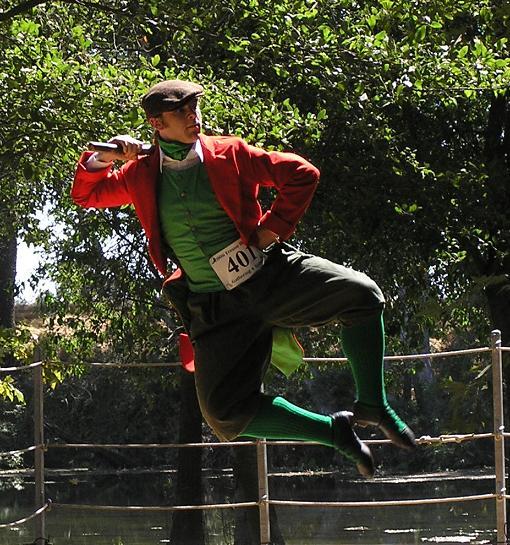
The guys wear tan pants that go to the knee, a white shirt, a vest, a jacket and knee high socks. The guys outfits also differ, usually with the age and level of the dancer. The guys also have props while they dance. The most common prop is a pipe.
Both guys and girls wear specialized jig shoes. They are either green or red and the have heels on them.
These two outfits are both for something called character dances. For more information on the background and history of the Sailor's hornpipe go to this website.
These costumes are only used by the top two levels of dancers in competition. The Hornpipe outfit is worn for a dance that imitates the sailors in wars so the dancers dress up as sailors.

They wear either blue or white long pants and matching long sleeve shirts. The dancers have there own hornpipe hat. The traditional ghillies are worn during this dance.
The Irish Jig outfit varies depending on boys and girls.

The girls wear a red or green dress and apron. The jig outfit is the outfit that varies most between each person. There are so many different designs. Almost no one has the same exact one.
The guys wear tan pants that go to the knee, a white shirt, a vest, a jacket and knee high socks. The guys outfits also differ, usually with the age and level of the dancer. The guys also have props while they dance. The most common prop is a pipe.
Both guys and girls wear specialized jig shoes. They are either green or red and the have heels on them.
These two outfits are both for something called character dances. For more information on the background and history of the Sailor's hornpipe go to this website.
Wednesday, November 11, 2009
What do Highland Dancers Wear? (Continued 1)
There is more than just the traditional highland outfit that highland dancers wear during competition. There is an outfit called a nationals.
This outfit includes a white under dress, a tartan skirt, a velvet lace up vest, and a plaid.
The white under dress is usually made out of a pattern of white, it is knee length, and has big sleeves.
The tartan skirt is bunched at the top so it is full. The dancer must have enough material in the skirt to hold it out straight. It has your choice of tartan pattern on it.
The velvet vest is similar to a kilt vest. The difference is the bottom of it is like flower pedals and the front laces up with a gold or silver lace depending on your tartan or a string with the same tartan as the skirt.
The plaid is a big rectangular piece of fabric the attaches at the dancers waist on the back of her costume. It is then pulled up and draped over her shoulder where it is pinned with your choice of a brooch.
There are a couple of things that can vary with this outfit. You do not have to wear it this way. There is a guide book that tells you the proper dress for your uniform. The way i described to you, is how i have always worn my outfit. It is personal preference for the dancer.
This outfit includes a white under dress, a tartan skirt, a velvet lace up vest, and a plaid.
The white under dress is usually made out of a pattern of white, it is knee length, and has big sleeves.

The tartan skirt is bunched at the top so it is full. The dancer must have enough material in the skirt to hold it out straight. It has your choice of tartan pattern on it.

The velvet vest is similar to a kilt vest. The difference is the bottom of it is like flower pedals and the front laces up with a gold or silver lace depending on your tartan or a string with the same tartan as the skirt.

The plaid is a big rectangular piece of fabric the attaches at the dancers waist on the back of her costume. It is then pulled up and draped over her shoulder where it is pinned with your choice of a brooch.

There are a couple of things that can vary with this outfit. You do not have to wear it this way. There is a guide book that tells you the proper dress for your uniform. The way i described to you, is how i have always worn my outfit. It is personal preference for the dancer.
Sunday, November 8, 2009
What do Highland Dancers Wear?
The highland dancer has four different costumes for competition. The most common outfit however is the highland or kilt outfit.
As a beginner dancer, this is the only outfit you need to compete. Once you start becoming a more advanced dancer you will need to buy other outfits so that you may compete other dances.
The highland outfit consists of a kilt with your choice of tartan (the pattern on the kilt). A velvet jacket or a vest with lace sleeves.
The jacket or vest should match one of the colors in the tartan of the kilt.
Knee high wool socks also known as hose. The hose have the same tartan as the kilt.
Finally for shoes you where leather thin dance shoes called ghillies.
All of this can be purchased from Scotland. Most beginner dancers however purchase their outfits from other highland dancers that have out grown their outfits. For most people once you get to the highest level you start to order your outfits and shoes from Scotland.
This is one of the many websites where you can buy this and other outfits from Scotland.

As a beginner dancer, this is the only outfit you need to compete. Once you start becoming a more advanced dancer you will need to buy other outfits so that you may compete other dances.
The highland outfit consists of a kilt with your choice of tartan (the pattern on the kilt). A velvet jacket or a vest with lace sleeves.
The jacket or vest should match one of the colors in the tartan of the kilt.
Knee high wool socks also known as hose. The hose have the same tartan as the kilt.
Finally for shoes you where leather thin dance shoes called ghillies.
All of this can be purchased from Scotland. Most beginner dancers however purchase their outfits from other highland dancers that have out grown their outfits. For most people once you get to the highest level you start to order your outfits and shoes from Scotland.
This is one of the many websites where you can buy this and other outfits from Scotland.
Sunday, November 1, 2009
My Personal Experience.
I have been doing Highland dancing since i was 7 years old. Now at the age of 14 I am still loving it. It has so many great benefits.
With all the training and practice I do it keeps me in great shape. It is my daily required exercise. I have great stamina and leg strength from it.
Another benefit is that I have a second family at my dance studio. All the girls I dance with are like my sisters and my dance teacher is like my mom. All the girls I dance with call our studio our home.
I have also made so many new friends across the U.S. I have traveled for competitions and I stay in touch with all the girls I have met. It has been such a great experience knowing people from Tennessee, California, and Texas. Traveling for competitions helps me to see all the different cultures of people across America.
Also I get to see famous monuments and amazing nature such as the St. Louis Arch, the famous changing colors of the New Hampshire leaves, beautiful mountains, rivers, and other amazing landscapes and breath-taking views.
Highland dance hasn't helped to only become a better dancer or stay in shape. It helps me to make new friends, develop social skills, experience new things, and appreciate how incredible our earth really is.
Here is a picture of me dancing at our regional competition in Alma Michigan when i was about 8 or 9 years old.
With all the training and practice I do it keeps me in great shape. It is my daily required exercise. I have great stamina and leg strength from it.
Another benefit is that I have a second family at my dance studio. All the girls I dance with are like my sisters and my dance teacher is like my mom. All the girls I dance with call our studio our home.
I have also made so many new friends across the U.S. I have traveled for competitions and I stay in touch with all the girls I have met. It has been such a great experience knowing people from Tennessee, California, and Texas. Traveling for competitions helps me to see all the different cultures of people across America.
Also I get to see famous monuments and amazing nature such as the St. Louis Arch, the famous changing colors of the New Hampshire leaves, beautiful mountains, rivers, and other amazing landscapes and breath-taking views.
Highland dance hasn't helped to only become a better dancer or stay in shape. It helps me to make new friends, develop social skills, experience new things, and appreciate how incredible our earth really is.
Here is a picture of me dancing at our regional competition in Alma Michigan when i was about 8 or 9 years old.
What is Highland Dance?
Highland dancing is an athletic, high endurance, non-partner type of dance. It requires long hours of training and practice. You must have very high stamina and strong leg and arm muscles.
Not many people have ever heard of this type of dance. Highland dancing has many similarities with other types of dancing but it also has differences.
Highland dancers have specific arm positions that they must use while they dance unlike Irish dancers who keep their arms at their sides. Highland dancers hold their arms above their head in specific positions or on their hips with their hands in fists.
Another difference is that while ballet dancers jump on the ball of their feet and then land flat footed, Highland dancers jump and land on the ball of their foot.
This however is the only main difference between highland and ballet. Highland dancing is actually very similar to ballet because like most dancing it is based off of ballet. The 6 basic feet and arm position of highland are all the same as the ballet positions.
If you still don't understand what highland dance is you can go to this link and read under the section of Basic Description of Highland Dancing. It may help you to better understand or give you more information on highland dance.
Not many people have ever heard of this type of dance. Highland dancing has many similarities with other types of dancing but it also has differences.
Highland dancers have specific arm positions that they must use while they dance unlike Irish dancers who keep their arms at their sides. Highland dancers hold their arms above their head in specific positions or on their hips with their hands in fists.
Another difference is that while ballet dancers jump on the ball of their feet and then land flat footed, Highland dancers jump and land on the ball of their foot.
This however is the only main difference between highland and ballet. Highland dancing is actually very similar to ballet because like most dancing it is based off of ballet. The 6 basic feet and arm position of highland are all the same as the ballet positions.
If you still don't understand what highland dance is you can go to this link and read under the section of Basic Description of Highland Dancing. It may help you to better understand or give you more information on highland dance.
Subscribe to:
Comments (Atom)